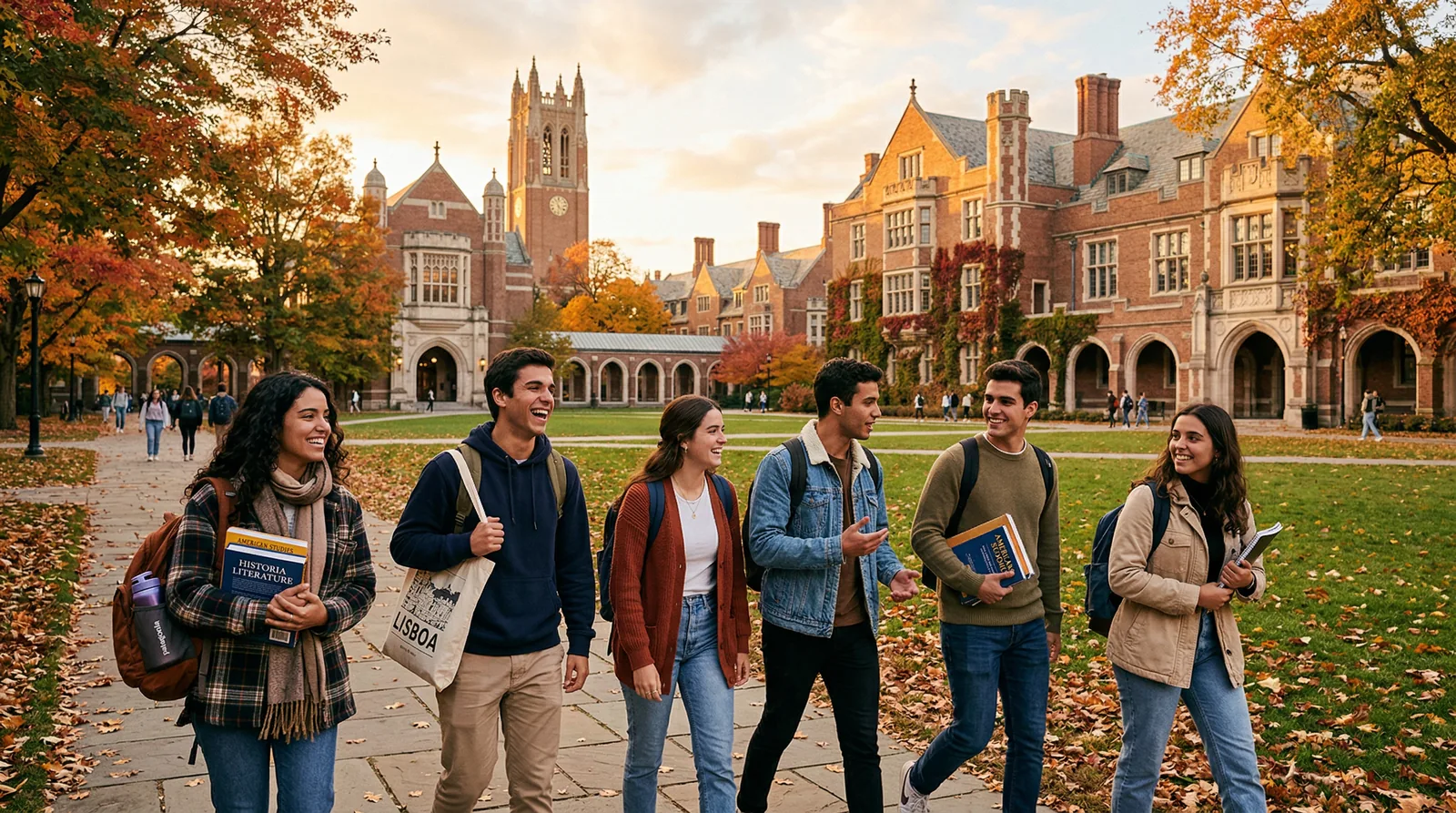
Spain has reached its largest-ever total of students studying in the United States, according to the IIE Open Doors 2025 Report. That headline belongs alongside India, China, and the other mega-senders — but almost nobody in U.S. graduate admissions is treating Spain as a strategic priority. That is a mistake, and this article explains exactly why.
This isn't a trendline that appeared last year. Over the past decade, Spain's outbound graduate mobility has been climbing steadily. The forces driving it are structural, not cyclical. And the competitive window for U.S. institutions is still wide open — most European competitors have noticed; most U.S. graduate programs have not.
The numbers: where Spain sits today
Spain appears in the IIE Open Doors 2025 Report as one of twelve countries in the top 25 sending nations to reach their all-time historical high in 2024/25. That is the headline. The context makes it more interesting: Spain is not a developing-market story with explosive growth from a low base. Spain is a mature, high-credential-quality market that has been growing steadily and is now accelerating.
Estimates for total Spanish students enrolled in U.S. institutions range from 6,000 to 8,000 annually, with graduate enrollment concentrated in master's programs and a growing doctoral cohort. The OECD Education at a Glance 2025 country note for Spain reports that 18% of 25–34-year-olds in Spain now hold a master's or equivalent degree — above the OECD average of 16% — which tells you something important: Spain already has a culture of advanced study, and a growing share of those students are looking abroad for it.
What the flow actually looks like
The standard estimate from IIE Open Doors and NAFSA is that Spain sends roughly 6,000–8,000 students to U.S. institutions per year across all degree levels. Within that pool:
- Graduate students (master's and PhD combined) make up an estimated 40–50% of the flow — a higher graduate share than the global average, reflecting Spain's credential inflation problem at home
- STEM and Business fields are disproportionately represented
- Female applicants are slightly in the majority, consistent with Spain's domestic enrollment patterns where women account for 54% of first-time tertiary entrants (OECD, 2025)
If your graduate program is in engineering, business analytics, public policy, or the life sciences, Spain is not a niche market. It is a primary European feeder — and most of your competitors are not actively recruiting there.
Top fields: what Spanish graduate applicants actually study
Based on inquiry patterns from virtual graduate fairs run with U.S. partner institutions, and consistent with Spain's domestic academic profile (OECD Education at a Glance 2024), the top fields drawing Spanish graduate applicants toward U.S. programs are:
1. Business and Management
Spain's domestic MBA market is strong but perceived as regionally limiting. Spanish students with 2–4 years of work experience are actively seeking U.S. MBA programs, particularly at schools with strong alumni networks in consulting and tech. The ROI narrative resonates clearly: U.S. MBA graduates earn significantly more than their Spanish counterparts, even adjusting for purchasing power.
2. Engineering and Computer Science
Spain graduates a substantial number of engineering students each year — and many of the best ones quickly discover that their Spanish degree does not translate into equivalent salaries domestically. A master's from a U.S. institution, especially at a program with STEM OPT eligibility, is understood to be a direct pathway to U.S. tech employment and a meaningfully higher salary trajectory.
3. Public Policy and International Affairs
Spain's political and administrative class has a long tradition of U.S. graduate education. MPP, MPA, and international affairs master's programs attract candidates from political science, economics, and law backgrounds. These applicants are often the most academically prepared and the most likely to convert quickly.
4. Life Sciences and Environmental Studies
Driven partly by EU-funded research culture and partly by domestic funding constraints at Spanish universities, PhD and master's applicants in biology, neuroscience, environmental science, and public health are increasingly targeting U.S. programs with funding packages — particularly RA-supported PhD positions.
5. Architecture and Urban Planning
A smaller but consistent flow. Spain's architecture schools are globally respected, and their graduates frequently pursue advanced degrees in the U.S. for specialization or professional reorientation.
Geographic distribution: Spain is not Madrid
Here is one of the most common mistakes U.S. admissions officers make when thinking about Spain: they equate the market with Madrid. The reality is more distributed.
- Madrid and surroundings (Community of Madrid): The largest single source, accounting for roughly 30% of outbound graduate students. High concentration of students from engineering, law, economics, and international affairs backgrounds.
- Catalonia (Barcelona and Girona): The second major cluster, with a strong tech and design orientation. Barcelona's startup ecosystem has created a generation of students who are explicitly entrepreneurial and increasingly interested in U.S. programs with ties to Silicon Valley or the Northeast corridor.
- Andalusia (Seville, Malaga, Granada): Often overlooked. Andalusia has Spain's second-largest university population — and arguably the most underserved in terms of career outcomes. Graduate mobility from this region is rising as domestic employment prospects remain persistently weak.
- Basque Country (Bilbao, San Sebastian): Smaller by population, but disproportionately represented in engineering and sciences. The Basque industrial base creates a cohort of engineering graduates who actively pursue graduate degrees for specialization.
- Valencia and Aragon: Growing clusters, particularly in engineering and environmental sciences, that remain almost entirely off the radar of U.S. recruiters.
The practical implication: if your recruitment strategy only covers Madrid, you are missing more than 60% of the market. The most cost-effective way to reach all of these regions simultaneously is through national-scale platforms. El Tour del Empleo, the largest university career network in Spain, reaches students across all of these regions through a single channel — including students at universities outside the major capitals who rarely see U.S. graduate recruiters at all.
Reach students across all of Spain's regions — in a single event
Reserve a booth at the October 20–21, 2026 Virtual Graduate Admission Fair for Spain & Portugal — powered by El Tour del Empleo. Booths start at $425.
See Packages →What's driving the trend: four structural forces
Application volume from Spain doesn't spike and crash the way it does from some markets. It is growing for structural reasons that are not going to reverse quickly.
1. Persistent graduate unemployment at home
Spain's graduate unemployment rate among 25–34-year-olds is 9.3%, well above the OECD average of 4.9% (OECD Education at a Glance 2025). For graduate students, the message is clear: a Spanish master's alone does not guarantee employment. International credentialing — particularly from the U.S. — is increasingly seen as the differentiator.
2. The U.S. salary premium
U.S. starting salaries in tech, consulting, and finance are 3–5x higher than equivalent Spanish salaries, in absolute terms. For a Spanish engineering graduate who has grown up watching Silicon Valley create wealth, the math is obvious. Even accounting for cost of living, the premium is substantial. This narrative is well understood among Spanish students under 30 and is a primary driver of U.S. graduate applications.
3. Post-Brexit redirection from the UK
Before 2021, the UK was the dominant English-language graduate destination for Spanish students — geographically close, culturally familiar, and well-integrated into EU academic frameworks. Brexit changed the calculus significantly. Tuition fees for EU students in the UK rose to international levels (typically £20,000–£30,000/year for master's programs). The legal and administrative complexity of UK student life post-Brexit increased. Many Spanish students who would have gone to London are now considering U.S. programs.
4. EU economic uncertainty and limited intra-EU mobility
Despite the Erasmus network, intra-EU graduate mobility has its limits. German and French universities that might absorb some Spanish graduate demand have their own language and credential barriers. The U.S. remains the single most legible destination for an English-proficient Spanish graduate who wants to maximize career optionality.
What admissions officers consistently miss
After reviewing the inquiry data from multiple virtual fairs and surveying admission officers who have recruited in Spain, three recurring blindspots stand out.
Spanish applicants are GMAT/GRE strong but SOP weak
Spain has a rigorous national university entrance exam system (PAU/EBAU), and its engineering and science programs are highly quantitative. Spanish applicants to business and STEM programs tend to perform well on standardized tests. What they are consistently underprepared for is the Statement of Purpose — a genre that simply does not exist in Spanish academic culture.
The practical implication: if your program's yield rate from Spanish applicants is lower than expected, check whether your SOP feedback or sample materials are calibrated for a non-native-English academic writing tradition. A brief guide to the U.S. SOP format, translated by a native Spanish speaker, often moves conversion rates meaningfully.
Most programs don't make credential equivalency explicit
The Spanish Grado (4-year bachelor's equivalent) and the older Licenciatura (5-year pre-Bologna degree) cause genuine confusion in U.S. admissions. Many programs are not explicit on their websites about whether they accept Spanish credentials at equivalency. Spanish applicants frequently abandon an application process when they hit this ambiguity — not because they don't qualify, but because the uncertainty is too costly to navigate without explicit confirmation.
Timing mismatches are losing good candidates
Spanish students researching U.S. graduate programs typically start 12–18 months before their intended enrollment. Many U.S. programs' recruitment communications are not optimized for a research cycle that begins in the student's third year. The prospect who starts asking questions in November of their final undergraduate year is not a late inquiry — they are on a Spanish timeline.
Build your Spanish graduate pipeline before October 2026
The Virtual Graduate Admission Fair for Spain & Portugal runs October 20–21, 2026. Booths start at $425. Powered by El Tour del Empleo.
View Packages →What this means for your 2026–27 recruitment cycle
If you are in U.S. graduate admissions and you are not running a Spain-specific strategy, this is what you are leaving on the table:
- A candidate pool that is growing, not shrinking — IIE Open Doors 2025 confirms Spain hit its all-time enrollment high in 2024/25
- English proficiency levels among the highest in continental Europe for the under-30 demographic
- Standardized test scores that are competitive with any European market
- F-1 visa approval rates among the highest in the world for European nationals
- A cultural and professional orientation toward the U.S. that is not going to weaken
The market is not going to wait. The institutions that build a Spain pipeline in 2026 will be working from a CRM list with two or three years of relationship history when their competitors finally show up.
"El Tour del Empleo connects more than 25 universities across Spain with over 100,000 students actively shaping their futures. Partnering with EasyVirtualFair allows us to open a direct bridge between graduate talent from Spain and Portugal and top American graduate schools."
— Aitor Zabala, Head of El Tour del Empleo
Start recruiting in Spain — without the trans-Atlantic trip
The October 20–21, 2026 Virtual Graduate Admission Fair for Spain & Portugal is the most efficient entry point. Booths start at $425.
Learn More at studyusaspain.kliri.com →Free Download
Get the full data: Spain Graduate Application Trends — 2026 Benchmark Report
14-page PDF with conversion funnel benchmarks, regional origin data, cost-per-channel comparisons, and the 5-step Spain recruitment playbook. No email required.
Download free report (PDF) →