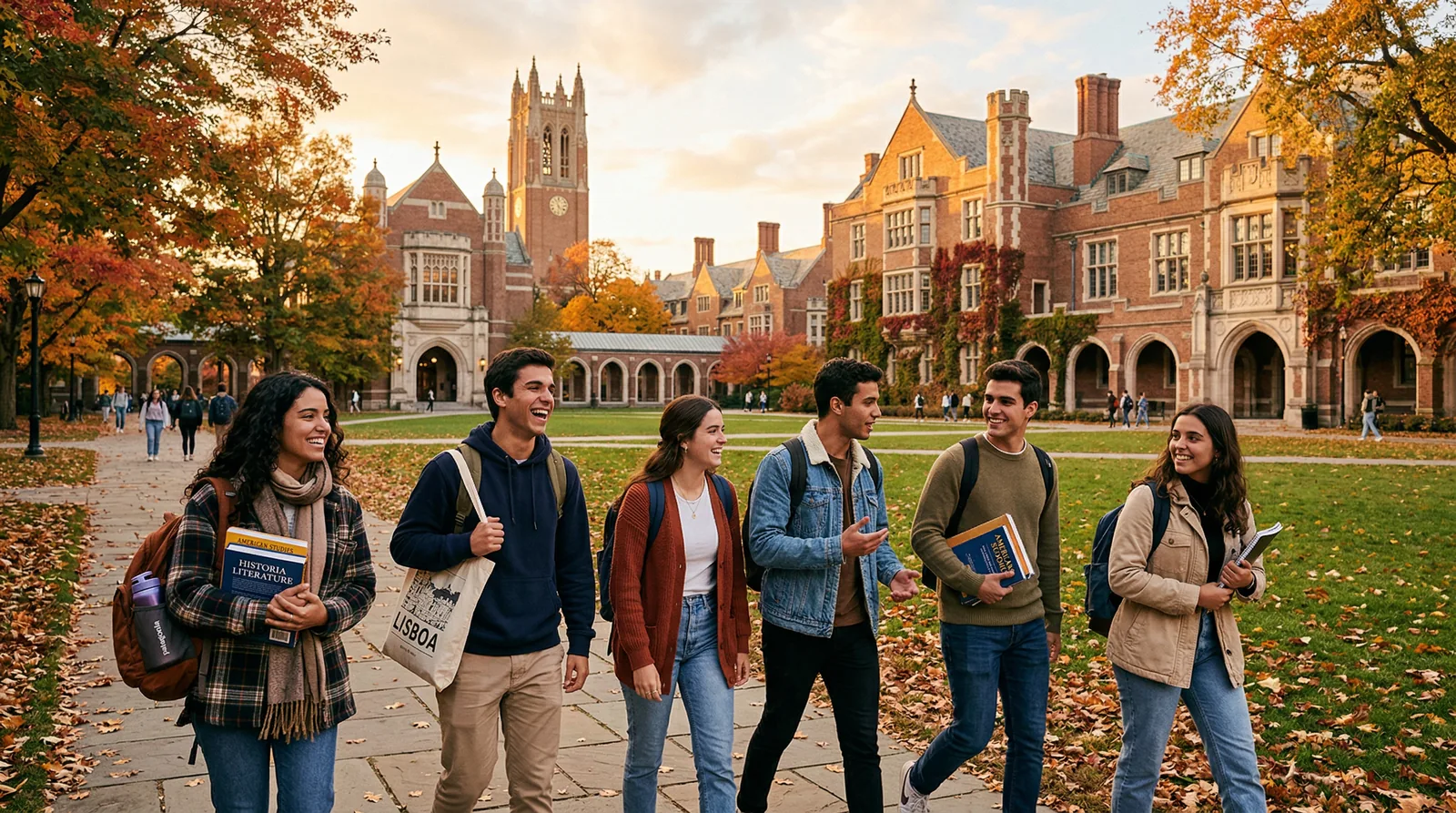
When Spanish or Portuguese candidates ask U.S. graduate admissions officers about the F-1 visa, they are rarely asking because they think they will be denied. They are asking because the process is opaque to them — multiple steps, unfamiliar government agencies, unclear timeline — and because they have heard horror stories from candidates in other countries that do not apply to their situation at all.
The good news for admissions officers recruiting in Iberia: Spain and Portugal are among the easiest markets in the world for F-1 visa processing. Approval rates are high, embassies are responsive, and the administrative infrastructure in both countries supports the process well. The challenge is communicating this credibly and accurately — without overpromising, and without getting into territory that belongs to immigration attorneys.
This article gives you the data, the timeline, the common failure points, and a clear framework for what to say when the visa question comes up at your next info session.
F-1 visa approval rates: what the data actually shows
Let's start with the number most likely to reassure your Spanish and Portuguese prospects — because most admissions officers don't know it precisely enough to use it confidently.
The U.S. State Department publishes annual nonimmigrant visa refusal rates by nationality. For B-visa (tourist/visitor) applications — which are a useful proxy for general U.S. consular attitudes toward nationals from a given country — the FY2024 adjusted refusal rate data from the State Department shows:
- Spain: 16.39% B-visa refusal rate
- Portugal: 7.91% B-visa refusal rate
For context: India's B-visa refusal rate is 16.32%, Nigeria's is 46.51%, and the global average is substantially higher than Spain's or Portugal's. However, it is the F-1 student visa data that is most relevant — and F-1 approval rates for European applicants are considerably better than B-visa rates. According to Inside Higher Ed's reporting on visa refusal data, the F-1 denial rate among European applicants has remained steady at approximately 9% in 2026, meaning roughly 91% of European F-1 applicants are approved.
That 91% approval rate is the number that matters. It is meaningfully better than global averages and dramatically better than rates for applicants from high-demand markets like India, China, or most of Africa. When a Spanish or Portuguese candidate expresses visa anxiety, this is the data point to reach for — delivered with appropriate caveats (individual circumstances vary, consular decisions are final).
Note: The elevated 2025 F-1 refusal rates reported globally by Inside Higher Ed (a decade-high 35% globally) are concentrated in high-risk markets. European denial rates have remained essentially flat, providing stable conditions for Spanish and Portuguese applicants.
The full F-1 process: step by step for Iberian applicants
Here is the standard timeline and process that applies to Spanish and Portuguese graduate students applying for an F-1 visa.
Step 1: Admission and I-20 issuance
The process starts when your program admits the student and your Designated School Official (DSO) issues the I-20 form. The I-20 is the foundational document for F-1 status — without it, the visa process cannot begin. Typical I-20 processing time at U.S. universities: 1–3 weeks after admission confirmation and receipt of financial documentation. For students aiming for a September start, this means I-20s should be issued by May–June to give sufficient processing time.
Step 2: SEVIS registration and fee payment
Once the student receives the I-20, they must register in SEVIS (the Student and Exchange Visitor Information System) and pay the SEVIS I-901 fee, currently $350 for F-1 students. SEVIS registration is done online at fmjfee.com. This must be completed before the visa interview is scheduled. Processing is typically immediate upon payment confirmation.
Step 3: DS-160 application and visa interview scheduling
The student completes the DS-160 nonimmigrant visa application online and schedules their consular interview. For Spain, interviews are conducted at the U.S. Embassy in Madrid and the U.S. Consulate in Barcelona. For Portugal, the primary interview location is the U.S. Embassy in Lisbon.
Wait times for interview appointments vary by season. During peak summer months (May–July), when most students are applying for fall semester visas, appointment wait times in Madrid and Barcelona can run 4–8 weeks. Students should schedule their interviews as early as possible — ideally in April or May for a September start — to avoid scheduling crunches.
Step 4: The consular interview
The F-1 consular interview is typically brief — 5–10 minutes — and focused on four core questions: What will you study? Where? How will you fund it? And what are your plans after graduation? Spanish and Portuguese applicants generally handle these interviews well. Language is rarely a barrier — interviews can often be conducted in Spanish or Portuguese, though English is preferred. The interview takes place in person; no proxy or remote interview is permitted.
Step 5: Visa issuance and travel
If approved, the visa is stamped in the passport and returned within a few business days. F-1 students may enter the U.S. up to 30 days before the program start date listed on their I-20. The entry is recorded in SEVIS and the student's F-1 status begins upon entry.
Documents required for the F-1 visa interview
Preparing your Spanish and Portuguese candidates with a clear document checklist is one of the most useful things an admissions officer can do. The standard list:
- Valid passport (must be valid for at least 6 months beyond the intended period of stay)
- DS-160 confirmation page
- SEVIS I-901 fee payment receipt
- I-20 form (issued by your DSO)
- Visa application fee payment receipt (MRV fee, currently $185)
- Financial documentation — bank statements showing sufficient funds to cover at least the first year of study (tuition + living expenses). For a typical U.S. graduate program, this means demonstrating access to $35,000–$70,000 depending on program and location. For funded PhD students, the official funding letter from the university is the key document.
- Academic transcripts and degree certificates (certified copies in English or with certified translation)
- Evidence of ties to home country — employment history, family ties, property ownership. This is the most counterintuitive requirement for many Spanish candidates, who understand it as needing to prove they will return to Spain after graduating.
- Admissions letter from the U.S. institution
- Optional but helpful: GRE/GMAT score reports, English proficiency test results (TOEFL/IELTS), scholarship award letters
Help your Spanish and Portuguese candidates understand the process
At the October 20–21, 2026 Virtual Graduate Admission Fair, candidates will ask about visa timelines. Having clear answers builds confidence and improves yield. Booths start at $425.
Reserve Your Booth →Common reasons for F-1 refusal — and why they are rare for Iberians
Understanding why F-1 visas get refused helps you help your candidates avoid the pitfalls. The leading reasons for F-1 refusal, in order of frequency:
1. Failure to demonstrate non-immigrant intent
The consular officer must be satisfied that the student intends to return to their home country after completing their studies. Spanish and Portuguese candidates generally have strong ties to home — family, existing career networks, EU citizenship advantages — which makes this easier to demonstrate than for candidates from countries with stronger emigration pressures. Still, candidates should be ready to articulate their post-graduation plans clearly and confidently.
2. Insufficient or undocumented financial resources
This is the most common practical reason for F-1 refusals in all markets. Financial documentation must be recent (typically within 3–6 months of the interview date), must show sufficient liquid assets or a reliable income stream, and must be clearly linked to the applicant. Third-party sponsors (parents, employers) are acceptable but require a support letter and documentation of the sponsor's financial capacity. For funded PhD students, a clear letter from the graduate school specifying the fellowship amount is typically sufficient.
3. Incomplete or inconsistent application documents
Discrepancies between the DS-160, the I-20, and supporting documents (different addresses, inconsistent names, date format issues) are a common source of delays and can trigger refusal. Advise candidates to double-check all documents for consistency before their interview.
4. Inadequate preparation for the interview itself
Some refusals are caused not by document problems but by a candidate who cannot clearly explain what they are studying, why they chose your program, or what they plan to do afterward. This is avoidable with basic interview preparation. A 15-minute mock interview — even self-prepared using the standard consular questions — meaningfully reduces this risk.
OPT and STEM OPT: what Spanish and Portuguese candidates need to know
Optional Practical Training (OPT) is the work authorization mechanism that makes U.S. graduate study compelling to career-focused Spanish and Portuguese applicants. Here is the key information:
Standard OPT
After completing their degree, F-1 students are eligible for up to 12 months of OPT — authorization to work in the U.S. in a job related to their field of study. OPT can also be used before graduation (pre-completion OPT), though this reduces the post-completion period. Students must apply for OPT through their school's DSO and USCIS — processing times can run 3–5 months, so applications should be filed as early as 90 days before graduation.
STEM OPT Extension
Students who graduate from a designated STEM program (science, technology, engineering, mathematics) are eligible for a 24-month STEM OPT extension, giving them a total of 36 months of U.S. work authorization after graduation. This is one of the most powerful recruitment tools available to STEM-focused U.S. programs recruiting in Iberia — Spanish engineering and computer science graduates with a clear path to 3 years of U.S. work experience are a fundamentally different value proposition than the same program without STEM OPT eligibility.
Requirements for STEM OPT extension: the employer must be enrolled in E-Verify, the position must be directly related to the STEM field of study, and the student must work at least 20 hours per week. Students report to their DSO every 6 months during the extension period.
What admissions officers should know about the cap-gap
Spanish and Portuguese graduates on OPT who apply for an H-1B visa (the most common next step for candidates who want to remain in the U.S. long-term) are subject to the annual H-1B cap. If their OPT expires before the H-1B takes effect (October 1 each year), they may be eligible for cap-gap protection, which automatically extends their OPT status. This is not something admissions officers should be advising on in detail — but knowing the concept exists allows you to mention it credibly and refer candidates to their international student office for specifics.
What admissions officers should say — and not say — about visas
This is the most important section of this article. Admissions officers are not immigration attorneys, and U.S. immigration law makes it risky to give specific visa advice. Here are the guardrails:
What to say
- "European F-1 applicants have approval rates around 91%. Spain and Portugal have some of the best track records in the world."
- "The process has several steps — I-20, SEVIS, DS-160, interview — and we can walk you through what each one involves. The timeline is typically 2–3 months from I-20 issuance to visa in hand."
- "Our DSO (Designated School Official) and international student office are your primary resources for visa support. They handle this process every cycle and will guide you through every step."
- "For funded PhD students, your funding letter from us is typically the key financial document for the consular interview."
What not to say
- Never guarantee visa approval. Consular decisions are sovereign; no outcome can be promised.
- Never advise on specific document strategies. "You should put X in the financial documentation to improve your odds" is immigration advising and beyond your scope.
- Never speculate on policy changes. Visa policy can shift. Cite the current data and refer candidates to USCIS and the State Department for authoritative information.
- Never minimize the non-immigrant intent requirement. It is real and candidates need to understand it, even if it is unlikely to be a problem for most Iberians.
Meet Spanish and Portuguese candidates who are ready to apply
The October 20–21, 2026 Virtual Graduate Admission Fair for Spain & Portugal connects your admissions team with pre-registered candidates from across Iberia. Booths start at $425.
See Packages →The recruitment opportunity in the visa conversation
Here is a reframe that experienced recruiters in the Iberian market use: the visa conversation is not a risk to manage — it is a trust-building opportunity. When a candidate asks about F-1 visas at your booth and you respond with accurate, specific, confident information — including the 91% approval rate, the step-by-step timeline, and the STEM OPT extension — you immediately differentiate yourself from the 80% of programs that deflect or give vague answers.
The candidate who leaves your booth knowing more about the F-1 process than they did before the conversation is more likely to apply. They associate your program with clarity and trustworthiness. That association compounds.
"El Tour del Empleo connects more than 25 universities across Spain with over 100,000 students actively shaping their futures. Partnering with EasyVirtualFair allows us to open a direct bridge between graduate talent from Spain and Portugal and top American graduate schools."
— Aitor Zabala, Head of El Tour del Empleo
Build your Iberian graduate pipeline in 2026
The Virtual Graduate Admission Fair for Spain & Portugal — October 20–21, 2026 — is the most efficient way to reach qualified Spanish and Portuguese graduate candidates. Powered by El Tour del Empleo. Visit studyusaspain.kliri.com to learn more.
Learn More →Free Download
Get the full data: Spain Graduate Application Trends — 2026 Benchmark Report
14-page PDF with conversion funnel benchmarks, regional origin data, cost-per-channel comparisons, and the 5-step Spain recruitment playbook. No email required.
Download free report (PDF) →Sources
- U.S. State Department — FY2024 Adjusted Refusal Rates by Nationality — travel.state.gov
- Inside Higher Ed — F-1 Student Visa Refusals Surged in 2025 — insidehighered.com
- SEVIS I-901 Fee — fmjfee.com
- USCIS — Optional Practical Training (OPT) for F-1 Students — uscis.gov
- NAFSA: Association of International Educators — nafsa.org
- IIE Open Doors 2025 — iie.org